
Agents
Describe the job once.
Swa keeps doing it.
A general assistant leaves everyone to work out their own way of using it. An agent is set up for a team's real job, runs under that team's rules, and leaves a record behind every action it takes.
Built in plain English. No code, no prompt engineering.
How an agent gets made
A sentence, then it runs.
Describe it
Say what the helper should do in the words you would use to explain it to a new colleague. Every weekday at nine, summarize overnight support tickets and post the top five to the ops channel.
Swa runs it
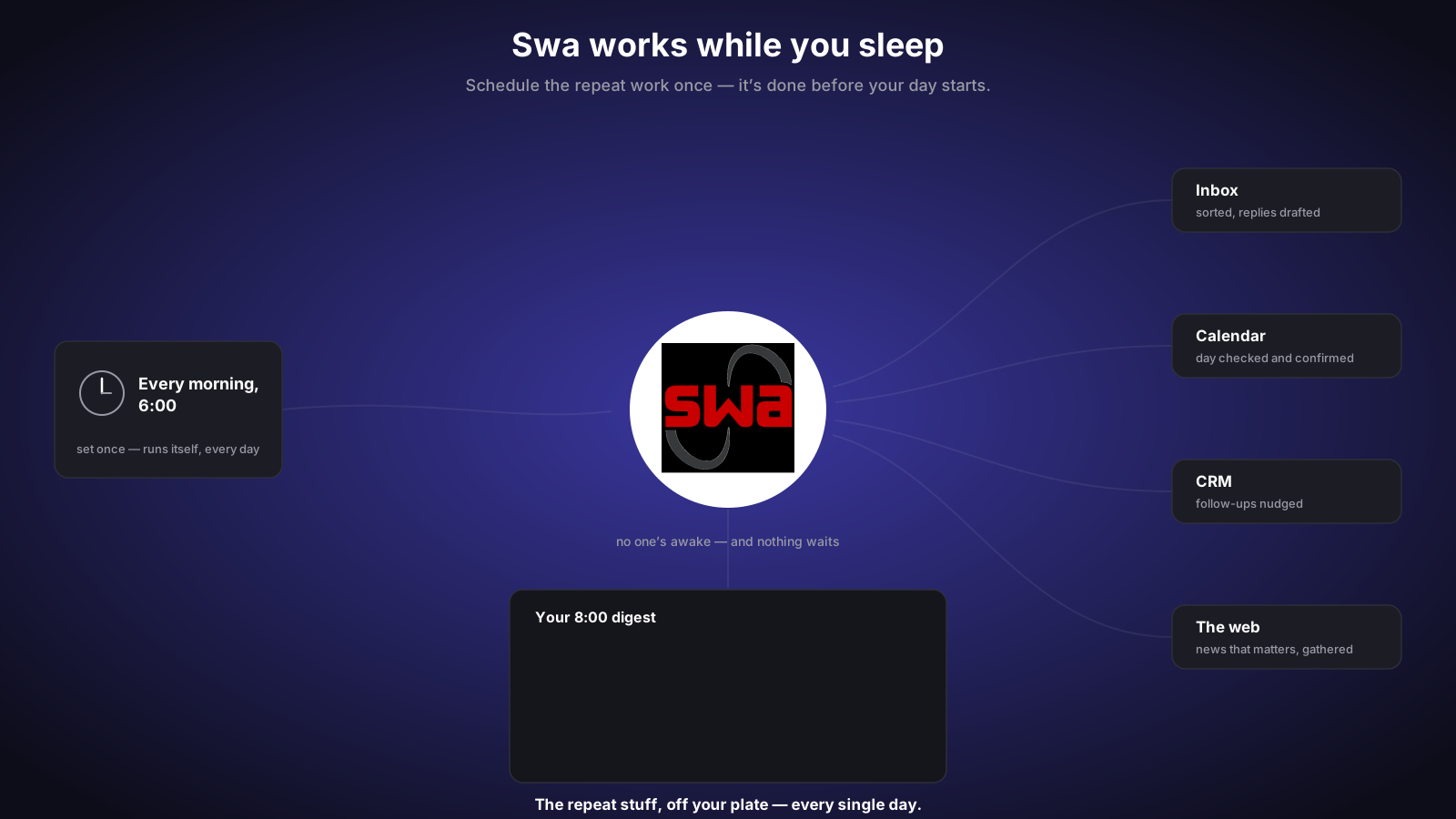
On schedule, on its own, using the systems it has been connected to and the library it has been given. Nobody has to remember to trigger it.
You get the result
Delivered where the team already is, with a record of what ran, what it touched, and what it came to on the balance.
Building them
The people who know the job build the helper.
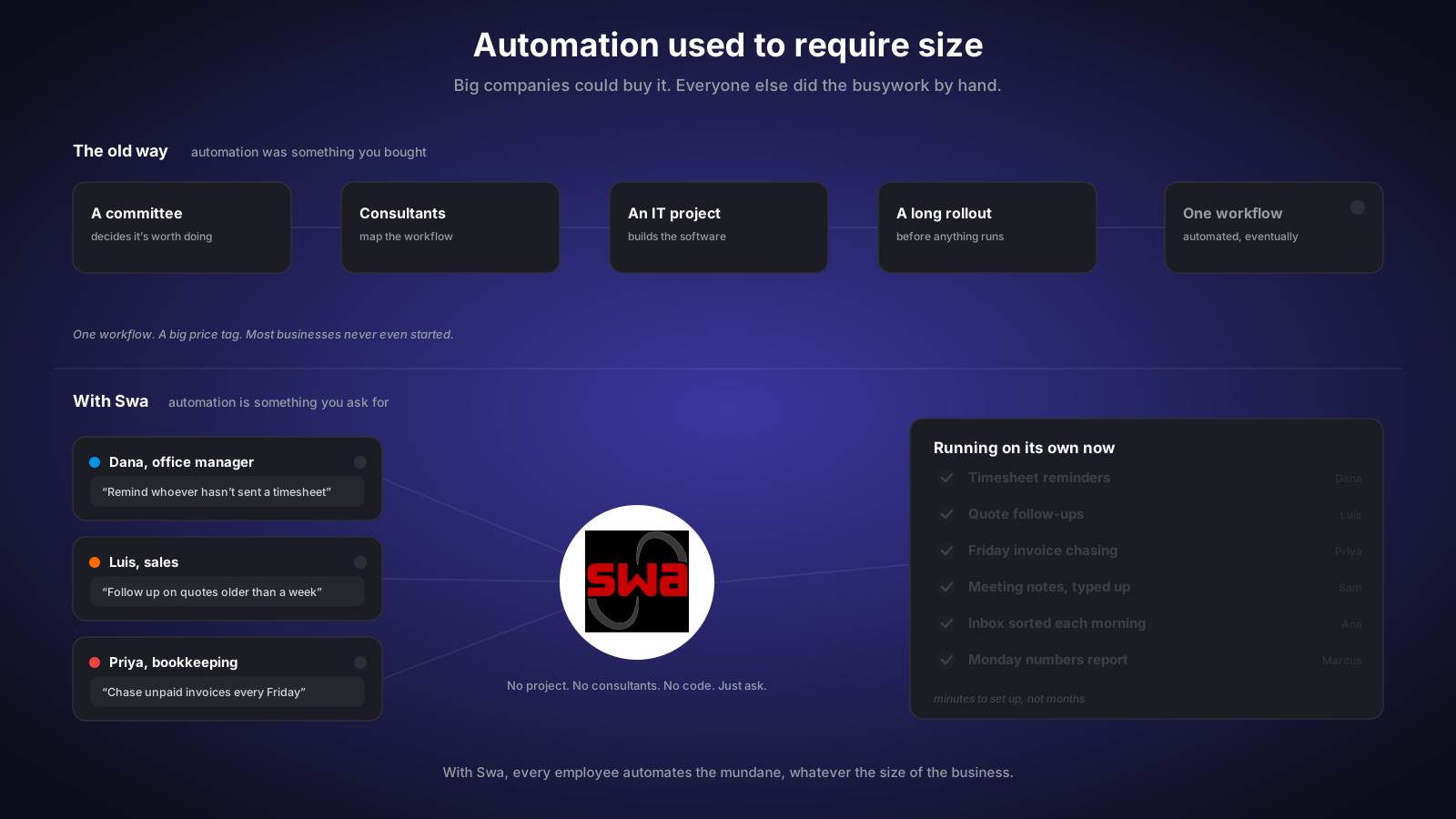
The person who understands a workflow is rarely the person who can write code against it. Agents are described in plain English, so the operations lead who knows what the report needs is the one who sets it up.

Built in plain English
Describe the helper you want and it exists. There is no builder canvas to learn, no scripting, and nothing that stops being editable once somebody who is not technical needs to change it.
Give it its own library
Hand an agent the contracts, policies, or spreadsheets it should answer from, and it answers from that library for everyone you share it with. Spreadsheets get exact answers, because Swa queries the numbers rather than skimming them.
Put it on a schedule
A recurring job described once runs on its own from then on, using everything it is connected to. The work happens whether or not anyone remembered it was Monday.
Share it with the team
An agent one person built is published to the people who need it, and it answers on whichever surface each of them prefers. Good ideas stop being one person's private shortcut.

Not just chat
Helpers that do the work, in the systems you already run.
An agent that can only answer questions moves the work from one person to another. Connected to the tools the business runs on, it files the ticket, moves the meeting, and finds the document, with a record behind every action.
Under the same rules
An agent is a user, and it is governed like one.
Agents are the point where AI stops being a conversation and starts taking actions on real systems, so they run inside the same governance as everything else rather than around the edge of it.

The team's rules, not its own
An agent works inside the compliance modules its workspace has switched on. What it may send, and which models may see it, are the same decisions that apply to the people on that team.
Right-sized on every run
Swa pairs each step with the right model rather than sending everything to the most expensive one. A job that runs every weekday for a year is where that difference adds up.
On the same balance
What an agent costs is priced and recorded like anything else, traceable to the automation that ran it. An agent left running is a line you can see, not a surprise at the end of a period.
Visible to the admins
Every agent the business has built is listed in the admin panel, along with which are actually being used. You can see the ones earning their place and the ones somebody made once and forgot.

Get started
Pick the job nobody wants to do on Mondays.
Describe it once, let it run for two weeks, and see whether anyone asks for it back. That is a short conversation, not a project.