Intelligent Routing: The AI Feature That Saves 10+ Hours Per Week
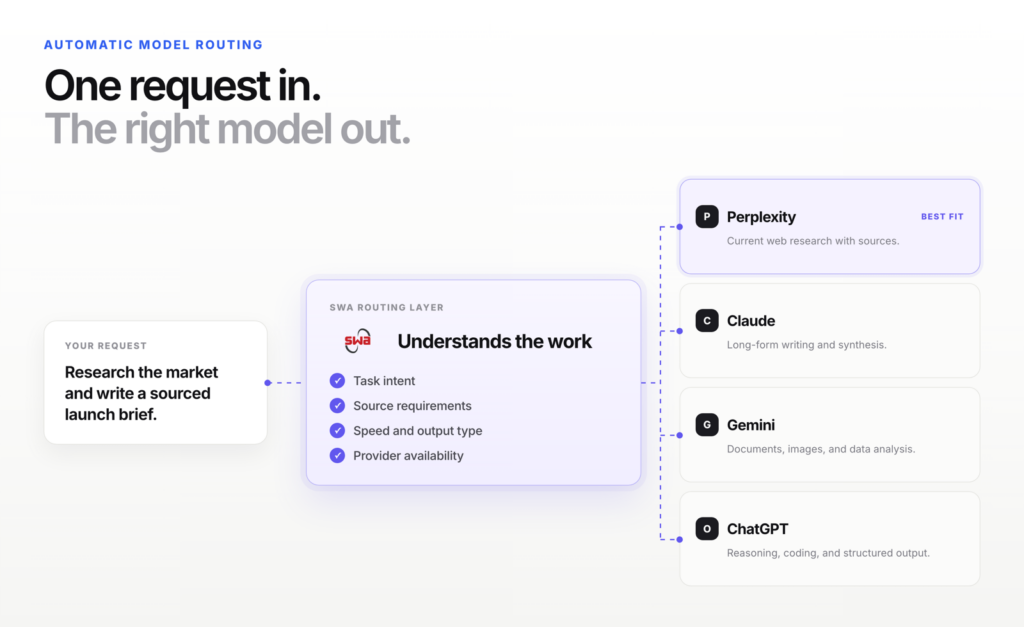
Stop choosing which AI to use. Let Swa choose for you.
Key takeaways
- Workers who save more than 10 hours per week with AI are not using a better model; they are using multiple models. That is a key finding from OpenAI’s 2025 enterprise research.
- Swa’s intelligent routing reads your query, identifies the task type, and sends it to the model best suited to respond. You do not have to choose. Swa knows which one to use.
- By 2028, IDC projects that 70% of top AI-driven enterprises will use intelligent model routing. The teams already doing it are pulling ahead now.
- The hidden time tax is not the work itself. It is the 8 to 15 minutes per task spent deciding which model to use, switching tools, re-pasting context, and validating the result.
- Code goes to DeepSeek. Research goes to Perplexity. Writing goes to ChatGPT. Analysis goes to Claude. Swa makes these calls automatically.
Scenario 1
Every morning your team opens a tab.
They have a task. They look at the tab. They wonder: is this the right tool for this?
They try that tool. The answer comes back okay, good enough. They move on.
Scenario 2
Your team opens a new tab to try a different model. Re-paste their context. Compare two answers. Pick one. Move on. Besides time-consuming, your company’s data has now trained two models.
That decision, made dozens of times a day, is costing your team more time than the AI is saving.
Thankfully, there is a fix; intelligent routing. Unfortunately, most teams have never used it.
The finding everyone missed in OpenAI’s 2025 research
OpenAI published enterprise AI research in 2025. Most coverage focused on the headline productivity numbers.
But there was a finding buried in the data that almost no one talked about.
Workers who save 10+ hours per week use multiple models. OpenAI State of Enterprise AI, 2025: time savings correlate directly with multi-model use, not with the quality of a single model. The biggest gains come from workers using several models across a wider range of tasks.
Read that carefully. The 10-plus-hours-per-week group was not using a better version of ChatGPT; they were not on a more expensive plan. They were using multiple models, across more tools, on a broader range of tasks.
The teams saving the most time figured out something the single-model users have not: the right model for the task matters more than the best model overall.
The problem is that figuring out the right model for each task, every time, adds friction and costs valuable time. It creates the very overhead teams are trying to avoid.
Swa’s intelligent routing removes friction by autonomously reading tasks and making routing decisions.
How much time does your team actually lose?
The honest answer is: more than anyone has tracked.
BetterUp Labs and Stanford research from September 2025 found that 41% of workers have encountered AI-generated output they had to redo. Each instance costs nearly two hours of rework. They named it “workslop”.
That rework is partly a model-selection problem. The wrong model for the task type produces output that sounds fine but does not hold up. The team reworks it. No one traces it back to issues with the original tool choice.
| Figure | What it measures | Source |
|---|---|---|
| 41% | of workers have reworked AI output that failed quality standards | BetterUp Labs + Stanford, 2025 |
| ~2 hrs | rework time per AI failure instance, on average | BetterUp Labs + Stanford, 2025 |
| 10+ hrs | saved per week by workers using multiple models vs single-model users | OpenAI State of Enterprise AI, 2025 |
| 70% | of top AI enterprises will use intelligent model routing by 2028 | IDC FutureScape 2026 |
Here is where it gets specific. These are some of the hidden time costs most teams have never measured:
| Task | Without routing | With Swa routing | Time saved |
|---|---|---|---|
| Deciding which model to use before starting a task | 5 to 15 min | 0 sec (Swa decides) | 5 to 15 min per task |
| Opening the tool, logging in, navigating to the right feature | 1 to 3 min | 0 sec (works in Slack) | 1 to 3 min per task |
| Re-pasting context after switching between tools | 2 to 5 min | 0 sec (one command) | 2 to 5 min per task |
| Validating output and comparing across two tools manually | 10 to 20 min | All models respond in one thread | 10 to 20 min per task |
| Reworking output that used the wrong model for the task type | Up to 2 hrs | Right model from the start | Up to 2 hrs per instance |
On a team running five to ten AI-assisted tasks per day, the friction cost alone adds up to two to three hours per person per day.
That is before counting the rework from wrong-model choices.
The paradox hiding in plain sight. 56% of CEOs reported zero measurable ROI from AI in the past 12 months (PwC Global CEO Survey, January 2026). McKinsey estimates that only 6% of companies capture outsized AI value. Those 6% have one thing in common: they redesign workflows end-to-end instead of bolting AI onto existing manual habits. Intelligent routing is the workflow redesign. It removes the manual decision that is creating overhead without adding value.
What intelligent routing does, exactly
Swa’s intelligent routing reads every query before it sends it anywhere.
It identifies the task type from the language of the query. Then Swa routes it to the model built for that task. The whole process happens in under a second. You never see it. You just get the right answer faster.
Here is what Swa’s routing looks like in practice:
| Task type | Swa routes to | Why that model wins here |
|---|---|---|
| Code review or debugging | DeepSeek | DeepSeek is purpose-built for technical accuracy and bug identification. It catches syntax errors and logic issues faster than general models. |
| Market research or fact-finding | Perplexity | Perplexity searches the web in real time and returns cited sources. No training data gaps. No hallucinated statistics. |
| Long-form writing or copywriting | ChatGPT | ChatGPT produces fluent, tone-matched prose. It adapts to brand voice and structures content for human readers. |
| Document analysis or deep reasoning | Claude | Claude handles long documents, nuanced reasoning, and multi-step analysis better than any general model. Ideal for strategy and compliance work. |
| Current events or competitive intel | Grok | Grok has real-time access to X platform data and excels at surfacing contrarian perspectives and breaking information. |
| Customer support responses | Claude | Claude’s careful, policy-aligned tone reduces escalation risk and handles sensitive interactions with appropriate nuance. |
| Image or video generation | GPT-Image or Sora / Gemini | Task type identifies creative generation. Swa routes to the right generative model based on format. |
| Brainstorming or ideation | ChatGPT or Grok | For open-ended creative problems, ChatGPT generates volume and Grok pushes unexpected angles. Swa uses context to decide. |
You do not configure any of this. You do not maintain it. Swa handles the routing layer so your team handles the work.
The science behind why this works
Intelligent routing is not a new idea. It is borrowed from one of the most proven principles in AI architecture.
The largest, most capable AI models in the world are already built this way.
IDC’s 2025 research noted something most teams do not know: providers of state-of-the-art models deliver them as Mixture of Experts systems. That means collections of task-specialized smaller models, hidden behind a single interface, where each prompt is routed to the specialized model that fits best.
GPT-4o is a Mixture of Experts model. So is Mixtral. So is Gemini 1.5.
The most advanced AI labs in the world use routing internally because specialization beats general capability on specific tasks. Every time.
What this means for your team. When you use a single model for everything, you are using the equivalent of one generalist for every job. When Swa routes your queries intelligently, you are using the right specialist for each task. The specialist wins on accuracy, speed, and reliability. That is not an opinion. It is how the best AI systems in the world are already built.
IDC’s 2026 AI and Automation FutureScape makes the trajectory clear: by 2028, 70% of top AI-driven enterprises will use advanced multi-tool architectures to dynamically manage model routing. The teams doing this today are not early adopters chasing a trend. They are operating the way everyone else will operate in two years.
Three ways teams use Swa’s routing right now
The morning brief
A sales team starts every day by asking @swa for a briefing. One message triggers Perplexity to pull overnight news on key accounts, Grok to surface any relevant market shifts, and Claude to synthesize the findings into a short brief posted to their Slack channel.
Without routing, this would require three separate tools, three separate logins, and twenty minutes of manual work. With Swa, it runs automatically before anyone is at their desk.
The code review pipeline
An engineering team added @swa to their pull request process. Every pull request (PR) gets a query. DeepSeek reviews for syntax and logic errors. Claude checks for security edge cases. The combined review posts to the PR thread before a human reviewer opens the file.
The routing layer decides which model sees which part of the query based on task type. No one configures it for each PR. Swa handles it.
The content draft
A marketing manager types: “@swa write a LinkedIn post about our new integration with Salesforce.” The query hits the routing layer. Swa identifies it as a short-form creative writing task. ChatGPT gets the job.
The manager did not choose ChatGPT. She did not think about whether Claude would be better. She did not open a second tab to compare. She typed one sentence and got a finished draft.
That is 10 to 15 minutes back. Per task. Every day.
What the research on single-model inefficiency shows
METR published a randomized controlled trial in July 2025 on developer productivity with AI. The finding caught the industry off guard.
Experienced developers using early-2025 AI tools took 19% longer on tasks than developers working without AI. The developers themselves predicted they would be 20 to 24% faster. They were measurably slower.
The research team noted several contributing factors. But one stands out for this discussion: developers using Cursor Pro and Claude 3.5/3.7 as their primary tools were using capable models that were not always the right model for the specific task at hand.
The friction of working around a model’s limitations, adjusting prompts to compensate, validating uncertain outputs, and switching when it did not work added overhead that erased the productivity gain.
The teams saving 10-plus hours per week are not fighting their tools. The right model is already handling the task before friction can build.
How much time does your team waste deciding which AI to use?
That is the question. And it has a real number attached to it.
If your team runs 10 AI-assisted tasks per day and spends an average of 8 minutes per task on model selection, tool switching, and context re-entry, that is 80 minutes per person per day. For a 20-person team, that is 27 hours of overhead every single day.
Intelligent routing removes that overhead at the source.
Swa’s routing layer makes the model selection in under a second. You use your workspace to query Swa and it automatically directs you to the right model. You read the response. You move on.
See intelligent routing in action
Swa routes queries to many top LLMs; ChatGPT, Claude, Perplexity, Grok, DeepSeek, Gemini, and more. No configuration. No maintenance. No tab switching.
- Works in your workspace, including your personal device with the Swa Solo app on Apple or Android devices
- Routing happens automatically based on your query type
- You can override and choose any model at any time
- Flat-rate pricing
- No per-user fees. The whole team gets access.
- Zero-retention architecture. Your data is never stored or trained on.
The teams saving 10 or more hours per week are not doing anything exotic. They stopped choosing which model to use. Swa makes that call for them.
Visit swa-ai.com to see intelligent routing in action. No credit card required. Setup in three minutes.
The Swa Team